
In this article
Top 10 AI Chatbot Breach Survival Guide for CISOs & CIOs
Introduction: The New Enterprise Attack Surface
In corner offices and midnight war rooms, the question that haunts every Chief Information Security Officer (CISO) is no longer “Are we secure?” but “Where is our next blind spot?” According to recent research, the proliferation of AI chatbots has created a sprawling new attack surface, often overlooked by traditional security audits. In 2024 alone, organisations ranging from Fortune 500 companies to government agencies have reported breaches directly tied to chatbot vulnerabilities, with attackers bypassing conventional defenses and exfiltrating sensitive data through seemingly innocent conversations. A breach within an enterprise AI ecosystem differs fundamentally from a traditional database exfiltration. It combines elements of data privacy violations, software supply chain vulnerabilities, API compromises, and a novel class of semantic exploits, including prompt injection and model manipulation.
Artificial Intelligence is no longer an experimental technology; we are witnessing the fastest technology adoption curve in human history. Corporate environments have normalised the use of generative AI chatbots for drafting code, analysing financial statements, summarising board meetings, and interfacing with proprietary customer data. Across industries, organisations are deploying AI chatbots, generative AI assistants, autonomous copilots, and conversational interfaces to improve productivity, automate workflows, enhance customer engagement, and accelerate decision-making. However, the pace of AI adoption has significantly outstripped the maturity of enterprise security controls designed to protect these systems. An AI chatbot breach is not simply a data breach involving an AI tool. It refers to any security incident where an AI assistant, generative AI platform, AI model, supporting infrastructure, or integrated ecosystem is exploited to expose sensitive information, manipulate outputs, disrupt operations, or facilitate broader cyberattacks. This growing imbalance has created an attractive target for cybercriminals.
For Chief Information Security Officers (CISOs), securing this frontier requires balancing business enablement with aggressive risk mitigation. This guide provides an enterprise-grade framework to help CISOs, Risk Directors, and Board Members anticipate, defend against, and survive a catastrophic AI chatbot breach, such as the recent case study from Meta, in which over 20,000 users' Instagram accounts were compromised.
Why AI Chatbots Have Become Prime Targets
Cybercriminals are increasingly targeting AI systems because they provide something traditional applications rarely offer: direct access to information, automation capabilities, and trusted decision-making processes.
Modern enterprise AI deployments often connect to:
SharePoint environments
Confluence knowledge bases
CRM platforms
Financial systems
Customer databases
Software repositories
Internal documentation platforms
Third-party SaaS applications
The Evolving Threat Landscape
To effectively defend the enterprise, security leaders must analyse how adversaries view and exploit AI ecosystems. Traditional cybersecurity models assume deterministic behavior: an application receives an input, processes it via explicit code logic, and delivers an output. Generative AI systems, by contrast, are probabilistic. They interpret natural language inputs, making their behavior inherently difficult to predict and secure.
Attackers exploit this fluid architecture across multiple vectors within the enterprise AI ecosystem:
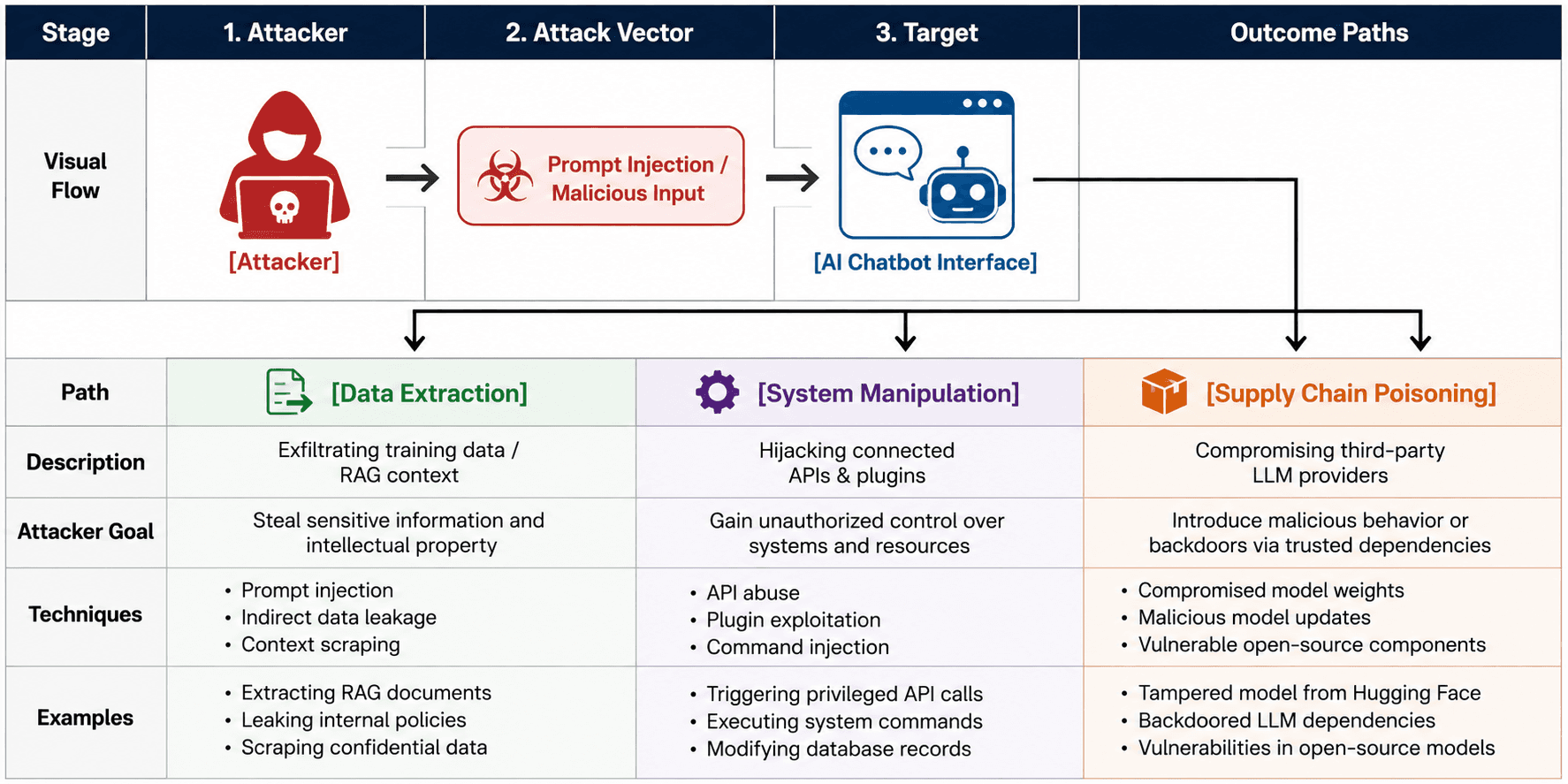
The Data Accumulation Vector: Chatbots operating via Retrieval-Augmented Generation (RAG) pull information from diverse corporate repositories (e.g., SharePoint, Confluence, Jira, and S3 buckets). An adversary who compromises the chatbot effectively gains a centralised key to the kingdom, bypassing isolated access controls.
The Semantic Interface Vector: Because the user interface is natural language, traditional signature-based security tools (like WAFs and IPSs) cannot easily differentiate between a legitimate complex query and a malicious prompt injection attack wrapped in benign prose.
The Software Supply Chain Vector: Enterprise AI rarely operates in isolation. It relies on a dense stack of open-source libraries (e.g., LangChain, LlamaIndex), foundational models hosted by third parties, and vector databases. Each component introduces distinct vulnerabilities, expanding the enterprise attack surface.
Securing these deployments requires moving past generic policies to address the specific failure modes of generative AI.
Top 10 AI Chatbot Breach Survival Guide for CISOs
1. Establish a Formal AI Model Risk Management and Governance Framework
Your organization cannot secure what it cannot see. Establishing a formal AI governance framework is the foundational AI security best practice, moving your program from reactive defense to strategic risk management. It creates a structured, top-down approach to understanding, quantifying, and mitigating the unique risks posed by AI systems across your entire enterprise.
This isn't just about compliance; it's about executive accountability and operational resilience. Without a formal framework, AI adoption becomes a "wild west" of shadow IT, where unvetted models introduce unknown vulnerabilities and business risks. A governance structure ensures every AI model has clear ownership, defined performance benchmarks, and a documented risk profile, preventing catastrophic failures before they occur.
Implementation Playbook
Create a Centralised Model Inventory: Your first step is to catalog every AI model in use or development. This registry should include the model’s owner, its business purpose, the data it uses, its dependencies, and its current risk assessment.
Define Risk Tiers and Ownership: Not all models are created equal. Classify models based on their potential impact (e.g., financial, reputational, safety) and assign a clear business and technical owner responsible for their lifecycle security.
Integrate with Existing Governance: Align your AI risk management with established frameworks like the NIST AI Risk Management Framework or ISO/IEC 42001. This prevents reinventing the wheel and ensures your AI security practices are defensible during audits. To build a solid foundation, you can learn more about how to structure a modern risk governance framework and adapt it to AI-specific challenges.
Establish an AI Governance Committee: Form a cross-functional team including security, legal, compliance, and business leaders to provide oversight, review high-risk models, and guide the organisation's overall AI strategy. This committee should report directly to executive leadership and the board.
CISO Takeaway: Governance is not a blocker to innovation; it is the foundational architecture that prevents catastrophic exposure. Security cannot protect what the organisation has not officially accounted for.
2. Secure AI APIs and Integrations
Adversaries target vulnerabilities in the APIs connecting chatbots to back-end databases, enterprise applications, and third-party orchestration layers. This includes exploiting broken object-level authorisation (BOLA) or weak authentication tokens within the AI middleware stack. Your AI model is only as secure as its weakest connection point. As AI systems increasingly rely on third-party services, data sources, and large language models (LLMs) via APIs, these integrations become high-value targets for attackers. Implementing robust API security and integration controls is no longer optional; it is a critical defense layer for modern AI security best practices.
Without stringent controls, unsecured APIs can expose sensitive data, allow unauthorised model manipulation, or enable denial-of-service attacks that cripple business operations. Treating API security as an afterthought creates a gaping hole in your security posture, turning your innovative AI service into an easily exploitable liability. A disciplined approach to securing these digital handshakes is essential for protecting your data, your models, and your customers.
Implementation Playbook
Deploy an API Gateway: Centralise control by using a gateway like AWS API Gateway, Azure API Management, or Kong. This allows you to enforce authentication, authorisation, rate limiting, and logging policies consistently across all AI-related services.
Enforce Strong Authentication and Authorisation: Secure every API endpoint with modern, token-based authentication protocols like OAuth 2.0 or OpenID Connect. Never rely on static, hard-coded API keys in client-side code. Implement role-based access control (RBAC) to enforce the principle of least privilege.
Implement Rigorous Key Management: Establish a strict policy for API key lifecycle management. This includes regular, automated rotation (e.g., quarterly), secure storage in a vault system, and immediate revocation upon any sign of compromise or employee departure.
Monitor and Log All API Traffic: Actively monitor all API calls for anomalous behavior, such as unusual spikes in requests from a single IP, unexpected error rates, or attempts to access unauthorised endpoints. Feed these logs into your SIEM for real-time threat detection and incident response.
CISO Takeaway: Never treat an AI system as a trusted insider. Validate every API request originating from a chatbot as if it came directly from an unverified user on the public internet.
3. Secure Prompt Engineering and LLM Input Validation
Attackers manipulate an LLM's behavior by crafting inputs that force the model to ignore its system instructions and execute unauthorised actions. This can occur directly via user input (Direct Prompt Injection) or indirectly when the chatbot processes a compromised external website, email, or document (Indirect Prompt Injection). This isn't just about filtering bad words; it's about defending the model's operational integrity. Without strict input validation and secure prompt design, LLMs become vulnerable entry points. An attacker could craft a malicious prompt to bypass safety filters, extract sensitive data from the model’s context window, or trick the AI into executing unauthorised actions, turning a productivity tool into a significant security liability.
Implementation Playbook
Establish a Secure Prompting Standard: Document and enforce a standard for how system prompts are constructed. Use clear, unambiguous instructions that define the AI’s role, boundaries, and forbidden actions. For a deeper dive into crafting effective and secure prompts, consider exploring prompt engineering to build a strong foundational skill set.
Implement Multi-Layered Input Validation: Sanitise and validate all user-provided inputs before they reach the LLM. Use techniques like allow-listing for expected input patterns and employ both rule-based and ML-based classifiers to detect and block potential prompt injection or jailbreaking attempts.
Filter and Monitor Model Outputs: Never trust model outputs implicitly. Implement output filtering to scan for and redact sensitive information, policy-violating content, or harmful instructions before they are presented to the user.
Log, Audit, and Test Continuously: Maintain immutable logs of all prompts and responses for incident investigation and compliance audits. Regularly perform adversarial testing (red teaming) to proactively identify new vulnerabilities and jailbreak techniques before they can be exploited.
CISO Takeaway: Traditional input filtering is insufficient for semantic layers. Security teams must assume that any input processed by an LLM can potentially override its core operating logic.
4. Access Control and Identity Management for AI Systems
AI chatbots connected to internal knowledge bases via RAG models pull data indiscriminately without respecting user-level permissions. This allows low-privilege users or external adversaries to extract highly confidential information simply by asking the chatbot for it. Your most critical assets are no longer just servers in a data center; they are the models, data pipelines, and APIs that power your intelligent systems. Implementing rigorous access control and identity management is a core AI security best practice that enforces the principle of least privilege, drastically reducing the attack surface from both external threats and insider risks.
This is about moving beyond simple passwords and treating every access request as a potential threat until verified. A robust identity framework ensures that only authorized users, services, and applications can interact with sensitive AI components. For organisations in regulated industries, like a financial firm using MFA and privileged access management (PAM) for its fraud detection models, this isn't just a good practice; it's a mandatory control for preventing unauthorised model tampering and data leakage.
Implementation Playbook
Enforce Multi-Factor Authentication (MFA): Mandate MFA for all human and service account access to AI platforms, model repositories, and data stores. This is the single most effective control for preventing unauthorised access resulting from credential theft.
Implement Role-Based Access Control (RBAC): Define granular roles for data scientists, ML engineers, model validators, and operators. Assign permissions based strictly on the requirements of their role, ensuring no single user has excessive privileges across the AI lifecycle.
Leverage Privileged Access Management (PAM): Secure administrative accounts with PAM solutions. Use just-in-time access and session monitoring for high-risk operations like deploying a model to production or modifying critical system configurations.
Automate Credential and Key Rotation: Implement automated processes to rotate service account credentials, API keys, and other secrets regularly, such as quarterly. This minimises the window of opportunity for attackers to misuse a compromised key.
Adopt a Zero Trust Mindset: This approach operationalises the principle of "never trust, always verify." You can learn more about how to apply these principles to your AI infrastructure and build a more resilient security posture by exploring how to implement Zero Trust security.
CISO Takeaway: An AI chatbot is only as secure as the underlying data layer. If your data access controls are broken, your AI security will be broken as well.
5. Implement Robust Third-Party AI Risk Management and Vendor Assessment
The enterprise relies on hosted third-party foundational models or external AI SaaS solutions without fully auditing their security postures, data handling policies, or dependency chains. As you integrate external AI models, platforms like Azure OpenAI, and specialized SaaS solutions, you are inheriting their risks. Implementing a formal third-party AI risk management program is not optional; it’s a critical control for protecting your data, maintaining compliance, and ensuring operational continuity.
Failing to properly vet AI vendors is equivalent to leaving a backdoor open into your enterprise. A vendor’s security flaw can quickly become your data breach, regulatory fine, or reputational crisis. A structured assessment process transforms vendor management from a simple procurement function into a strategic security discipline, ensuring every third-party AI system meets your organisation's non-negotiable security and compliance standards.
Implementation Playbook
Develop an AI-Specific Vendor Questionnaire: Go beyond standard security questionnaires. Ask pointed questions about the vendor’s model training data, data segregation and protection controls, model testing methodologies, and their own supply chain security for the libraries and platforms they use.
Verify Compliance and Certifications: Don't just take their word for it. Request and review current audit reports and certifications like SOC 2 Type II, ISO 27001, and attestations of HIPAA or CMMC compliance. This provides independent validation of their control environment.
Establish Contractual Security Requirements: Embed security obligations directly into your vendor contracts. Include clauses for incident notification timelines, data residency, right-to-audit, and minimum-security baselines. Ensure clear service level agreements (SLAs) cover security performance. To effectively systematize this process, it is crucial to leverage a robust framework, as outlined in a practical guide to third-party risk management.
Conduct Regular Re-assessments: Risk is not static. Perform annual or bi-annual reviews of critical AI vendors to ensure their security posture has not degraded and remains aligned with evolving threats and compliance needs. You can learn more about how to structure a modern third-party risk management program and adapt it to AI-specific challenges.
CISO Takeaway: When outsourcing your AI infrastructure, you cannot outsource your security accountability. Treat your AI providers as high-risk, tier-one infrastructure partners.
6. Implement Continuous AI Security Monitoring
Security Operations Centers (SOCs) treat AI chatbots as standard web applications, failing to monitor for AI-specific telemetry such as anomalous semantic drift, embedding distribution shifts, prompt token consumption anomalies, and adversarial manipulation patterns. Deploying an AI model is not the end of the security lifecycle; it is the beginning of its operational risk. Continuous monitoring, coupled with robust explainability and interpretability practices, transforms your "black box" models into transparent, auditable assets. This practice is essential for detecting performance degradation, identifying adversarial manipulations, and understanding the logic behind automated decisions. Without this visibility, your models are silent vulnerabilities waiting to be exploited. A perfectly accurate model today could make biased, unsafe, or wildly incorrect predictions tomorrow due to data drift or a subtle poisoning attack. Continuous monitoring provides the real-time feedback loop needed to maintain model integrity and trustworthiness, ensuring your AI systems operate safely and as intended.
Implementation Playbook
Establish Key Performance and Risk Indicators: For each model, define and track metrics beyond simple accuracy. Monitor for data drift, concept drift, prediction latency, and fairness metrics (e.g., disparate impact).
Implement Explainability Tooling: Integrate explainability techniques like SHAP (Shapley Additive exPlanations) or LIME (Local Interpretable Model-agnostic Explanations) into your MLOps pipeline. This allows you to document and audit the rationale behind high-stakes predictions.
Automate Alerting and Response: Configure automated alerts to notify your security operations center (SOC) and model owners when key metrics breach predefined thresholds. Integrate these alerts into your existing incident response workflow for swift investigation and remediation.
Conduct Regular Model Reviews: Schedule monthly or quarterly reviews with business stakeholders, data scientists, and security teams. Use monitoring dashboards and explainability reports to assess model health, validate decision logic, and confirm ongoing alignment with business objectives.
CISO Takeaway: You cannot defend against threats you cannot see. Modern enterprise AI security demands specialised semantic telemetry to catch advanced adversarial behaviors.
7. Encryption, Key Management, and Data Protection for AI Systems
The data fueling your AI models is often your most valuable and sensitive asset. Protecting it with robust encryption is not just a defensive measure; it’s a core tenet of responsible AI development and a non-negotiable compliance requirement. Implementing end-to-end encryption and disciplined key management ensures that data, from raw training sets to model outputs, remains confidential and secure throughout its lifecycle, whether at rest, in transit, or during processing.
This practice is the bedrock of data-centric AI security. Without it, even the most secure models are vulnerable if their underlying data is exposed. A breach of training data can lead to model poisoning, privacy violations, and severe regulatory penalties. Proper encryption transforms sensitive data into a protected asset, rendering it useless to unauthorised parties and creating a defensible security posture against both internal and external threats.
Implementation Playbook
Encrypt All Data At Rest and In Transit: Mandate strong encryption, like AES-256, for all training data, model files, and configuration secrets stored in databases, object storage, or file systems. Enforce TLS 1.2 or higher for all data moving between services, from data ingestion pipelines to API endpoints serving model predictions.
Centralise Key Management: Leverage cloud-native services like AWS Key Management Service (KMS), Azure Key Vault, or Google Cloud KMS to manage encryption keys. These services provide centralised control, hardware security module (HSM) backing, and detailed audit logs, simplifying one of the most complex aspects of cryptography.
Implement Automated Key Rotation and Granular Access: Configure automated, periodic rotation of all encryption keys (e.g., every 90 days) to limit the impact of a potential key compromise. Use identity and access management (IAM) policies to enforce the principle of least privilege, ensuring that only authorised services and personnel can access specific keys.
Document and Audit Your Encryption Strategy: Formally document your encryption policies, key management procedures, and data classification standards. Regularly conduct internal audits to verify that controls are implemented correctly and align with frameworks like the NIST SP 800-175B guidance on key management, ensuring your practices are always audit-ready.
8. Secure AI Model Development and Supply Chain Security
Your AI model is only as secure as its weakest link. Securing the AI development lifecycle and its complex supply chain is a critical best practice that prevents vulnerabilities from being coded directly into your most valuable assets. It treats AI models like critical software, applying rigorous DevSecOps principles to the entire MLOps pipeline, from data ingestion and code commits to model deployment and monitoring.
This process involves embedding security controls at every stage, not as an afterthought. Without a secure development lifecycle, your organisation is exposed to supply chain attacks where malicious code hidden in third-party libraries or datasets can compromise your models, steal proprietary information, or introduce subtle biases. Implementing supply chain security ensures the integrity, authenticity, and resilience of every component used to build and run your AI systems.
Implementation Playbook
Integrate Security Scanning into CI/CD: Embed Static Application Security Testing (SAST) tools directly into your CI/CD pipeline to scan all machine learning code for vulnerabilities before it is committed. Similarly, use tools like Trivy or Grype to scan container images used for model deployment.
Manage Dependencies and Third-Party Libraries: Maintain a "bill of materials" for every model, documenting all open-source libraries, datasets, and pre-trained models. Use dependency scanning tools to continuously monitor these components for known vulnerabilities and automate patching.
Secure the Model Registry: Treat your model registry (e.g., MLflow, AWS SageMaker Model Registry) as a critical asset. Implement strict role-based access controls, require models to be cryptographically signed before registration, and maintain immutable audit logs of all activity.
Enforce Secure Coding and Review Practices: Mandate secure coding training for all ML engineers and data scientists. Implement a mandatory peer-review process for all code and model architecture changes, ensuring a second set of eyes validates security and logic before deployment.
9. Conduct Regular Red Teaming and AI Security Assessments
Organisations rely purely on conventional automated vulnerability scanners to evaluate their AI systems. These tools look for missing patches and outdated software dependencies but fail to detect flaws in semantic logic, guardrail resilience, or prompt injection resistance. Proactive adversarial testing and red-teaming directly address this gap by simulating sophisticated attacks, moving your security posture from a defensive stance to an offensive one. This practice involves deliberately attacking your own models to discover how they fail, identifying weaknesses before malicious actors can exploit them. This isn't standard penetration testing; it’s a specialised discipline focused on AI-specific attack vectors like prompt injection, data poisoning, and model evasion. By combining this rigorous testing with a dedicated AI incident response plan, you ensure your organisation can not only withstand an attack but also contain, analyse, and recover from it with minimal business disruption.
Implementation Playbook
Integrate Adversarial Testing into the MLOps Pipeline: Embed automated adversarial testing into your model development and deployment lifecycle. Use frameworks like the Adversarial Robustness Toolbox (ART) to test for vulnerabilities like evasion and poisoning before models reach production.
Conduct AI-Focused Red-Team Exercises: Engage specialised teams to perform goal-oriented attacks on your critical AI systems. This provides an unbiased assessment of your defenses, from the model itself to the surrounding infrastructure and human processes. For a deeper understanding of this process, you can explore the services offered by the top penetration testing companies.
Develop a Dedicated AI Incident Response Plan: Your general IT incident response plan is insufficient for AI failures. Create a specific playbook that defines procedures for AI-specific incidents, such as model poisoning, large-scale data leakage, or catastrophic model failure, and aligns with frameworks like the NIST Cybersecurity Framework.
Run AI-Specific Tabletop Exercises: Regularly conduct incident response simulations with key stakeholders from security, legal, data science, and business units. Test scenarios like a compromised fraud detection model or a poisoned medical diagnostic AI to refine your team’s readiness and communication protocols.
CISO Takeaway: AI systems require adversarial validation. If your team is not actively attempting to break your models, cybercriminals will do it for you.
10. Prepare for Regulatory and Compliance Fallout
Following an AI chatbot breach, the enterprise focuses solely on technical remediation, neglecting complex, evolving global regulatory mandates governing AI security, data privacy, and automated decision-making. Align your enterprise security program with emerging international frameworks such as the ISO/IEC 42001 (Artificial Intelligence Management System standard) and the NIST Artificial Intelligence Risk Management Framework (AI RMF). Establish rigorous logging to provide explicit auditability for all automated decisions. Notify regulatory agencies within the required legal windows (e.g., SEC disclosure rules, GDPR 72-hour timeline); document all technical security controls active at the time of the breach to demonstrate defensive due diligence; engage external privacy counsel immediately.
CISO Takeaway: Global regulators are treating AI security with heightened scrutiny. Compliance failure can easily eclipse the direct technical remediation costs of an active breach.
From Best Practices to Business as Usual: Securing Your AI Future
The journey through these ten AI security best practices reveals a fundamental truth: securing artificial intelligence is not a final destination, but a continuous, dynamic process. We have moved beyond the theoretical and into the realm of the operational, detailing the critical controls necessary to transform AI from a high-potential asset into a resilient, trustworthy business driver. This is no longer a niche IT concern; it is a board-level imperative that directly impacts your organisation's competitive edge, regulatory standing, and market reputation.
The most successful CISOs will not treat AI security as a standalone technology challenge. Instead, they will integrate AI governance, AI risk management, and AI incident response into every stage of the AI lifecycle. Security leaders should assume that AI systems will eventually become targets and build programmes capable of detecting, containing, and recovering from those attacks before they threaten business operations. In the AI era, resilience, not prevention alone, will define successful cybersecurity leadership.
How BridgeLynk Can Help
Artificial intelligence is creating unprecedented opportunities for innovation, productivity, and business transformation. However, the same technologies that accelerate growth can also introduce new categories of cyber risk that many organisations are not fully prepared to manage.
At BridgeLynk, we help organisations adopt AI securely by combining cybersecurity expertise, governance frameworks, and practical risk management strategies tailored to modern enterprise environments.
Our services support organisations throughout the AI lifecycle, including: Our capabilities include: AI Security Assessments, AI Governance and Risk Management, AI Threat Detection and Monitoring, Third-Party Risk Assessments, and Adversarial Security Testing.
As enterprise AI adoption continues to accelerate, organisations require more than technical controls alone. They need a trusted cybersecurity partner capable of helping them manage risk while enabling innovation. BridgeLynk supports organisations throughout their AI security journey by helping them reduce AI-related cyber risk and build resilient, secure AI environments.
References:
Our Articles
Top 10 AI Chatbot Breach Survival Guide for CISOs & CIOs
In corner offices and midnight war rooms, the question that haunts every Chief Information Security Officer (CISO) is no longer “Are we secure?” but “Where is our next blind spot?” According to recent research, the proliferation of AI chatbots has created a sprawling new attack surface, often overlooked by traditional security audits. In 2024 alone, organisations ranging from Fortune 500 companies to government agencies have reported breaches directly tied to chatbot vulnerabilities, with attackers bypassing conventional defenses and exfiltrating sensitive data through seemingly innocent conversations. A breach within an enterprise AI ecosystem differs fundamentally from a traditional database exfiltration. It combines elements of data privacy violations, software supply chain vulnerabilities, API compromises, and a novel class of semantic exploits, including prompt injection and model manipulation.
Critical Remote Code Execution (RCE) in AI Automation Tool n8n — "Ni8mare"
A critical unauthenticated RCE vulnerability (CVE-2026-21858, CVSS 10.0) in the popular AI workflow tool n8n allows attackers to read sensitive server files and escalate to full remote code execution. Here is what you need to know.
Critical vulnerability affecting Cisco Catalyst SD-WAN - CVE-2026-20127
A maximum-severity vulnerability (CVSS 10.0) in Cisco Catalyst SD-WAN controllers is being actively exploited in the wild. Attackers are bypassing authentication, escalating to root, and establishing persistent access across enterprise network infrastructure.
Notepad++ Update Feature Hijacked by Chinese State Hackers for Months
Between June and December 2025, Chinese state-linked hackers from the Lotus Blossom group hijacked the Notepad++ update mechanism to deliver a custom backdoor to millions of users. Here is a full breakdown of what happened and what organisations must do now.
GitHub Confirms Breach of 4,000 Repositories Through Malicious VSCode Extension
GitHub has confirmed a significant security breach involving nearly 4,000 internal repositories after a malicious Visual Studio Code extension was installed on an employee's device. The trojanised Nx Console extension harvested credentials including GitHub tokens, AWS keys, and 1Password vault data.