
In this article
Critical Remote Code Execution (RCE) in AI Automation Tool n8n — "Ni8mare"
Introduction
n8n is an open-source AI workflow automation platform. Versions starting with 1.65.0 and below 1.121.0 enable an attacker to access files on the underlying server through execution of certain form-based workflows. A vulnerable workflow could grant access to an unauthenticated remote attacker, resulting in exposure of sensitive information stored on the system and may enable further compromise depending on deployment configuration and workflow usage. This issue is fixed in version 1.121.0.
Vulnerability Summary
TLP: Green
CVE: CVE-2026-21858
CVSS Score: 10.0 (Critical)
CVSSv3.1: AV:N/AC:L/PR:N/UI:N/S:C/C:H/I:H/A:N
MITRE ATT&CK: TA0002 – Execution / T1674 – Input Injection
Affected Versions: >= 1.65.0 and < 1.121.0
Fixed Version: 1.121.0
Severity: Critical
Detailed Analysis
The vulnerability, dubbed "Ni8mare" by its discoverer — security researcher Dor Attias from Cyera, an Israeli-founded data security company — is rooted in insufficient sanitisation and improper handling of file uploads in n8n's webhook processing logic. Specifically, the flaw exists in the HTTP header Content-Type field when set to multipart/form-data.
Because no authentication is required to interact with publicly exposed n8n workflows, any remote attacker who can reach the service can exploit this flaw.
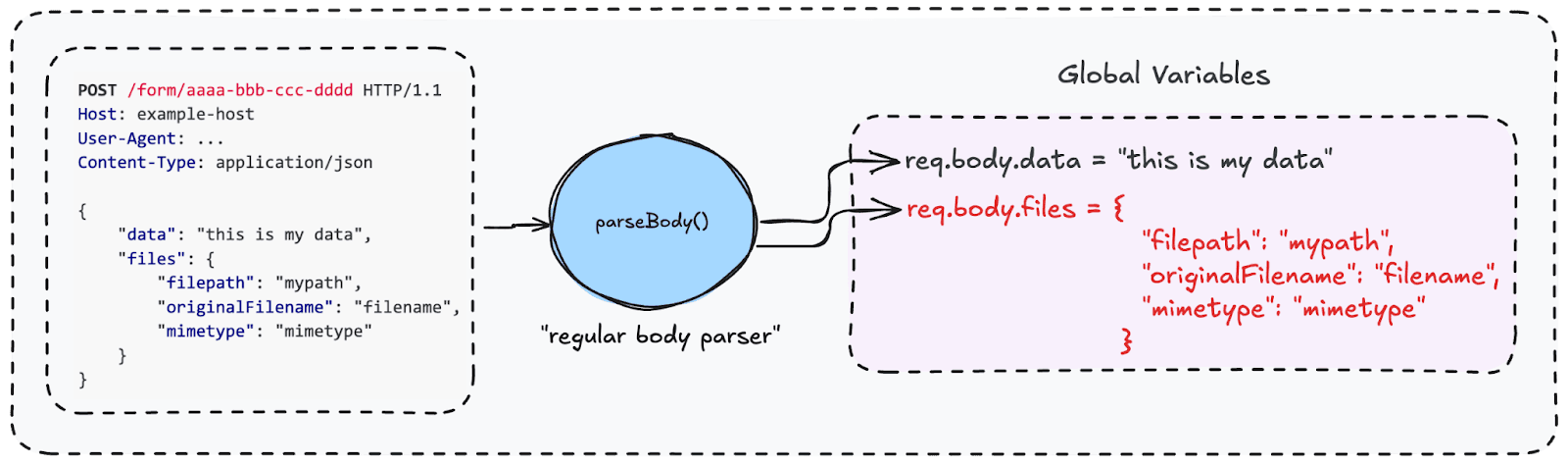
Image Credit - Cyera.com - images shows how an adversary could override req.body.files global variable
A vulnerable workflow could grant access to an unauthenticated remote attacker, resulting in exposure of sensitive information stored on the system and may enable further compromise depending on deployment configuration and workflow usage.
How the Attack Works
Exploitation of Ni8mare follows a clear and dangerous three-stage escalation path.
In the first stage, an attacker manipulates the req.body.files variable within a vulnerable form-based workflow. By pointing this variable to any file readable by the server process — such as /etc/passwd — and interacting with n8n's built-in chat interface, the attacker can directly retrieve the file's contents.
In the second stage, the same technique is used to extract the n8n SQLite database, which stores usernames, email addresses, hashed passwords, and the secret key n8n uses to generate cookie session tokens. Armed with this secret key, an attacker can forge a valid session token for any user account on the platform, enabling full privilege escalation without needing to crack a single password.
In the third and final stage, once authenticated to the n8n server, the attacker creates a workflow containing an Execute Command node — a legitimate n8n feature — to run arbitrary operating system commands on the underlying server, completing the chain from unauthenticated file read to full remote code execution.
Affected Versions
= 1.65.0 and < 1.121.0
Mitigation Strategies
There is no known workaround for this vulnerability. The only effective remediation is to upgrade to n8n version 1.121.0 or later, which contains the official patch.
Beyond patching, BridgeLynk recommends the following defensive measures for organisations running n8n or similar webhook-enabled workflow engines:
Do not expose your n8n instance directly to the internet. Where internet access is operationally necessary, place the service behind an authenticated reverse proxy, web application firewall (WAF), or VPN.
Implement authentication controls on sensitive workflow endpoints. Workflows that handle file uploads or interact with AI knowledge bases should require credential verification before execution.
Conduct a security audit of your n8n deployment and all connected workflow engines. Review which workflows are publicly accessible and assess the data they can reach.
Monitor for anomalous process execution on hosts running n8n, particularly any child processes spawned by the n8n service that interact with system files or network connections.
How BridgeLynk Can Help
AI automation tools are rapidly becoming central to how organisations operate — and as adoption grows, so does the attack surface. BridgeLynk works with organisations to assess the security posture of AI and automation tooling, identify exposed attack surfaces before adversaries do, and implement controls that reduce risk without slowing down operations.
Learn more about how BridgeLynk partners with you to improve organisational security maturity and risk reduction.
Our Articles
Critical Remote Code Execution (RCE) in AI Automation Tool n8n — "Ni8mare"
A critical unauthenticated RCE vulnerability (CVE-2026-21858, CVSS 10.0) in the popular AI workflow tool n8n allows attackers to read sensitive server files and escalate to full remote code execution. Here is what you need to know.
Critical vulnerability affecting Cisco Catalyst SD-WAN - CVE-2026-20127
A maximum-severity vulnerability (CVSS 10.0) in Cisco Catalyst SD-WAN controllers is being actively exploited in the wild. Attackers are bypassing authentication, escalating to root, and establishing persistent access across enterprise network infrastructure.
Notepad++ Update Feature Hijacked by Chinese State Hackers for Months
Between June and December 2025, Chinese state-linked hackers from the Lotus Blossom group hijacked the Notepad++ update mechanism to deliver a custom backdoor to millions of users. Here is a full breakdown of what happened and what organisations must do now.
GitHub Confirms Breach of 4,000 Repositories Through Malicious VSCode Extension
GitHub has confirmed a significant security breach involving nearly 4,000 internal repositories after a malicious Visual Studio Code extension was installed on an employee's device. The trojanised Nx Console extension harvested credentials including GitHub tokens, AWS keys, and 1Password vault data.